Owned: SWOT Analysis of e.l.f. Beauty
e.l.f. Beauty was founded in 2004 and has become one of the fastest-growing companies in the beauty industry. However, its recent growth is more due to higher prices and the acquisition of rhode rather than more people purchasing e.l.f. products. The main issue is how e.l.f. can win back new customers and what role communication can play in this process.
Strengths
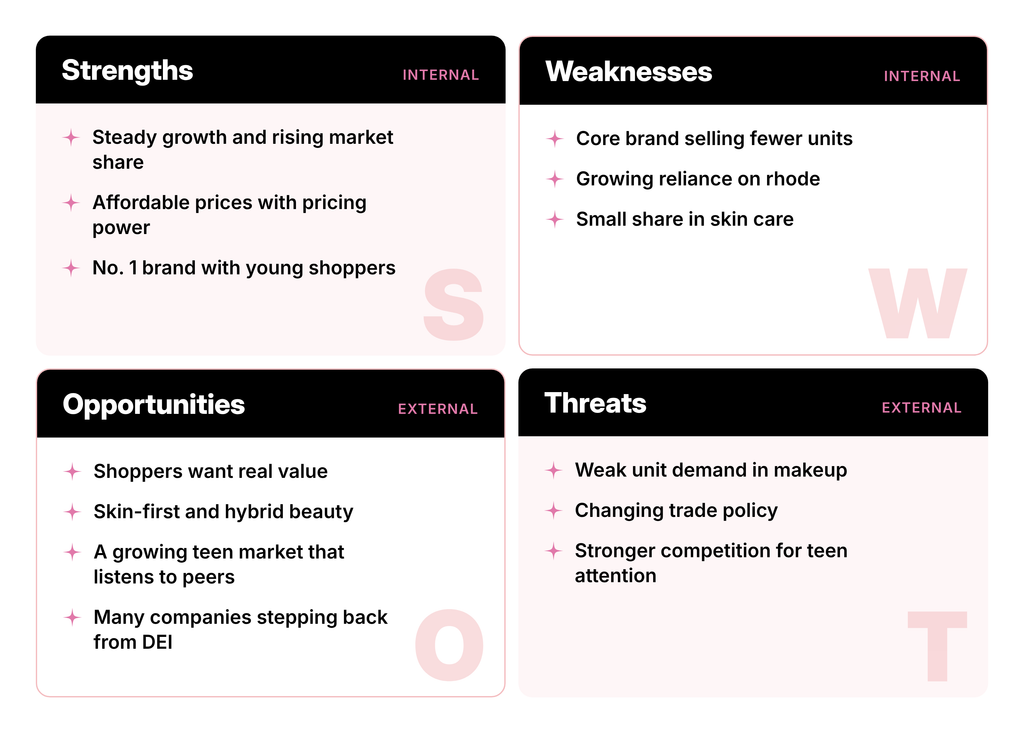
- Steady growth and rising market share
In the first quarter of fiscal 2027, e.l.f. Beauty announced its 30th consecutive quarter of net sales growth. CEO Tarang Amin also said the e.l.f. brand gained more market share in the past year than any other top 10 brand, even while its growth slowed (e.l.f. Beauty, 2026c).
Why it matters: The 30 quarters of sales growth indicate that this upward trend comes from a repeatable model rather than being driven by a single best-selling product. e.l.f. Beauty now has four brands with more than $200 million in retail sales, and Amin says each one is built on the same three things: strong value, fast innovation and a “disruptive marketing engine” (e.l.f. Beauty, 2026c).
Reflection: A long-term sales growth trend can also raise people’s expectations. As shown below, the sources of growth have begun to change, so this advantage needs to be protected.
- Affordable prices with pricing power
On average, the price of e.l.f. Cosmetics products is approximately $7, while the prices of legacy mass brands are over $10, and those from high-end brands are over $30 (e.l.f. Beauty, 2026c). After e.l.f. raised prices by $1 in August 2025, unit sales dipped, but total sales still grew (e.l.f. Beauty, 2026c).
Why it matters: Pricing power means a brand can raise prices without losing too many customers. e.l.f. showed this after its $1 increase, since most shoppers kept buying at the higher price. In a May 2026 price test, going back to a lower price did not win back enough buyers for about 90% of products (e.l.f. Beauty, 2026c). This suggests shoppers think e.l.f. products are worth the price, even when they are not the cheapest choice.
Reflection: This pricing advantage is limited to a certain extent. Even after the price increase, e.l.f. products are still much cheaper than most competitors. Affordability is the biggest selling point of this brand, so any future price changes need to be communicated carefully.
- No. 1 brand with young shoppers
In Piper Sandler’s fall 2026 survey of U.S. teens, e.l.f. remained the top cosmetics brand (Investing.com, 2026). Amin said e.l.f. is the most purchased brand among Gen Z, Gen Alpha and millennials. Its unaided awareness grew from 13% to 45% in just a few years (e.l.f. Beauty, 2026c).
Why it matters: e.l.f. is the top choice across three generations, which indicates that consumers do not stop buying it after graduating from high school. Amin also said about one in three U.S. women buy e.l.f. Cosmetics, which means two-thirds of the market is still open to the brand (e.l.f. Beauty, 2026c). Because so many people already know e.l.f., its main challenge is turning people who know e.l.f. into people who buy it.
Reflection: Most of these numbers come from the company itself. The independent Piper Sandler survey tells a more mixed story. e.l.f. is still No. 1, but it lost 3 percentage points of mindshare, while rhode rose to No. 3 (Investing.com, 2026). Teen tastes change fast, so this lead is not guaranteed.
Weaknesses
- Core brand selling fewer units
In the first quarter of fiscal 2027, e.l.f. Beauty’s growth mainly came from higher prices and more expensive products, while the number of units sold went down, cutting about 3 percentage points from growth. Amin said the $1 price increase brought in more money, but it also meant fewer products were sold (e.l.f. Beauty, 2026c).
Why it matters: This means e.l.f. is making more money on each product, but people are buying fewer of them. For a brand built on making beauty affordable for more people, this is a serious warning sign. Management seems to agree. The company plans to spend most of its $50 million tariff refund on more marketing and lower prices for some products to win back unit sales (e.l.f. Beauty, 2026c).
Reflection: However, CFO Mandy Fields said last year’s numbers were unusually high because some products were shipped early and a new lip balm sold very well that year (e.l.f. Beauty, 2026c). Also, the whole mass makeup market is selling fewer products. But Amin’s own comments show the price increase played a role too.
- Growing reliance on rhode
The rhode brand, which e.l.f. Beauty bought in 2025, added about $160 million in sales in the first quarter. The company expects it to add about 13 percentage points of growth in fiscal 2027 (e.l.f. Beauty, 2026c).
Why it matters: More of the company’s growth now depends on a brand that e.l.f. acquired, and rhode is closely tied to its founder, Hailey Bieber. If Bieber gets involved in any controversy, it could quickly damage rhode’s image. Since rhode is expected to provide about two-thirds of the company’s growth this fiscal year, this would also hurt e.l.f. Beauty’s overall performance.
Reflection: The two-thirds figure may make the risk look bigger than it is. e.l.f. Beauty did not own rhode a year ago, so all of rhode’s sales count as new growth until August (e.l.f. Beauty, 2026c). But this does not change the fact that rhode depends heavily on Bieber.
- Small share in skin care
e.l.f. SKIN has become the No. 11 mass skin care brand in the U.S., but it holds only a 2% share, compared with 13% for the No. 1 brand (e.l.f. Beauty, 2026c).
Why it matters: Skin care is one of the strongest parts of the beauty market (Circana, 2026). A small share there means e.l.f. is missing part of that growth. This is also a problem for hybrid products. If shoppers only see e.l.f. as a makeup brand, they may not trust its skin care benefits.
Reflection: However, this is mainly a problem for the e.l.f. brand, not for the whole company. Largely thanks to rhode and Naturium, skin care now makes up nearly 25% of e.l.f. Beauty’s sales (e.l.f. Beauty, 2026c).
Opportunities
- Shoppers want real value
In the first half of 2026, U.S. prestige and mass beauty sales both rose 7%. Circana’s Larissa Jensen said consumers are willing “to shop across price tiers, selectively investing in products that deliver the strongest emotional and functional value” (Circana, 2026).
Why it matters: Shopping across price tiers means even shoppers who like prestige beauty are also willing to buy mass beauty products. This widens e.l.f.’s market beyond budget shoppers. It also fits how e.l.f. builds products. It takes inspiration from popular prestige items and sells its own version for much less (e.l.f. Beauty, 2026c).
Reflection: This opportunity is limited to a certain extent, because consumers do not want to save money on every product. Prestige skin care sales grew 9% in the first half of 2026 (Circana, 2026). This suggests that many consumers are willing to spend more money on skin care, rather than save on it, but skin care is also the weakest area of the e.l.f. brand. Although the company can still attract these consumers through rhode, the e.l.f. brand itself may not benefit as much as expected.
- Skin-first and hybrid beauty
According to Circana, more than half of U.S. consumers look for products that combine makeup and skin care, including just over 60% of Gen Z and millennials (Famiano, 2024).
Why it matters: e.l.f. is strong in makeup but weak in skin care, as noted in the third weakness. The brand already sells products that mix color and care, and its Bubble collaboration added three more hybrids in 2026 (e.l.f. Beauty, 2026a). Consumers who already trust e.l.f. makeup may be more willing to try its skin care products in this way.
Reflection: However, other brands can also see this trend, and Bubble itself is also a competitor. e.l.f. has also not shared how well the Bubble collection sold, so it is still unclear whether consumers really want its hybrid products.
- A growing teen market that listens to peers
Piper Sandler’s fall 2026 survey found that teen beauty spending grew 7%. It also found that 87% of teen girls said influencers and friends shape what they buy, while only 37% mentioned beauty retailers (Piper Sandler, 2026, as cited in Werner, 2026).
Why it matters: As the most popular brand among teens, e.l.f. can benefit from the growth of the teen beauty market. However, the way teens choose products is even more important. They listen to people more than stores, and TikTok is now one of their top 10 favorite places to shop for beauty (Investing.com, 2026). This matches e.l.f.’s current way of doing business. The brand launched its new e.l.f. Hair line on TikTok Shop before bringing it to Target (e.l.f. Beauty, 2026c).
Reflection: However, this also means that e.l.f. cannot fully control how people see the brand. Teens trust creators and friends more than brands, so negative reviews can spread just as fast as good ones.
- Many companies stepping back from DEI
A growing number of major U.S. companies have scaled back or set aside their diversity, equity and inclusion programs (Associated Press, 2025).
Why it matters: When most companies go quiet on DEI, the few that keep their promises get more attention. e.l.f. says it is one of fewer than 1% of about 3,700 U.S. public companies with a board that is at least 60% women and at least 40% diverse (e.l.f. Beauty, 2026b). It also says a diverse board helps it “stay culturally relevant,” which shows that its stance is also connected to business (e.l.f. Beauty, 2024).
Reflection: However, standing out also means being judged. As one of the few companies still openly supporting board diversity, e.l.f. is more likely to become a target of criticism or boycotts. But if it suddenly steps back, consumers may think the brand does not keep its promises. The payoff may also be limited, since most shoppers likely care more about price and quality than a company’s board.
Threats
- Weak unit demand in makeup
In the first half of 2026, mass makeup sales rose 5%, but the number of units sold declined. At the same time, mass fragrance sales grew 15% (Circana, 2026).
Why it matters: This has a bigger impact on e.l.f. than on most other brands. Its products cost about $7 on average, so it depends on selling many units (e.l.f. Beauty, 2026c). High-end brands can make up for lower sales volume through higher prices, but it is much harder for e.l.f. to do this.
Reflection: A weak category does not mean e.l.f. is losing. The brand still gained more market share than any other top 10 brand in the past year (e.l.f. Beauty, 2026c). Although gaining market share is still a good sign, it is more difficult for e.l.f. to turn it into sales growth when the whole market is selling fewer products.
- Changing trade policy
Reuters reported that e.l.f. expected more than $50 million in extra tariff costs in fiscal 2026 (Bedi & Mistry, 2025). Then, in the first quarter of fiscal 2027, the company received about $50 million in tariff refunds. Amin said only 1% of production came from outside China a few years ago, and the company expects that number to reach about 60% by the end of fiscal 2027 (e.l.f. Beauty, 2026c).
Why it matters: For a low-price brand, higher costs are hard to absorb and hard to pass on to consumers.
Reflection: The risk is getting smaller as e.l.f. moves production to more countries, although new tariffs could also affect those countries. But costs went up and then came back as refunds, which shows how unpredictable trade policy is.
- Stronger competition for teen attention
In Piper Sandler’s fall 2026 survey, teen girls’ favorite skin care brands included newer names such as Bubble and the Korean brand Medicube (Piper Sandler, 2026, as cited in Werner, 2026).
Why it matters: e.l.f.’s lead with teens is one of its biggest strengths, and much of its marketing is built on it. The new rivals target the same young shoppers through the same social channels. As more brands compete for teens’ attention, e.l.f.’s top spot will be harder to hold.
Reflection: One of the fastest-rising brands is rhode, which e.l.f. Beauty owns. If some teens are moving from e.l.f. to rhode, the company still keeps their spending, even if the e.l.f. brand does not. But the survey does not show whether this is actually happening.
Strategic Insights
e.l.f. still has the trust, prices and teen popularity that built the brand. But the core brand needs new buyers, and its biggest growth areas, skin care and hybrid products, are where it is weakest.
1. Make hybrid skin care and makeup a core e.l.f. line
Rationale: This responds to the drop in units (W1), the small skin care share (W3), the hybrid trend (O2) and weak makeup demand (T1). The Bubble collaboration was a limited-edition collection (e.l.f. Beauty, 2026a), and e.l.f. can turn that test into a permanent skin care and makeup line. New categories can also bring in new customers. Nearly half of e.l.f. Hair buyers were new to the brand (e.l.f. Beauty, 2026c).
Success metrics: By the end of fiscal 2028, return e.l.f. brand unit sales to growth. Within 12 months of launch, make sure at least 40% of buyers of the new line are new to e.l.f.
2. Build trust in e.l.f. SKIN through clear, ingredient-focused education
Rationale: This responds to the small skin care share (W3), the reliance on rhode (W2) and the skin-first trend (O2). Shoppers are willing to spend more on skin care, so they need proof that a product works before they choose a cheaper option. e.l.f. Beauty already has strong skin care know-how through rhode and Naturium. It can use that expertise to explain what is in e.l.f. SKIN products and why they work. The launch of e.l.f. SKIN at Dollar General this fall is a good moment to start (e.l.f. Beauty, 2026c).
Success metrics: Within two years, move e.l.f. SKIN from No. 11 into the top 10 U.S. mass skin care brands. Within 12 months, increase by 15% the number of shoppers who agree that “e.l.f. SKIN products work,” measured through brand surveys.
3. Win back teen mindshare through creators and real-life moments
Rationale: This responds to e.l.f.’s teen popularity (S3), the influence of peers (O3) and new competition (T3). Teens trust friends and creators more than stores. e.l.f. can expand creator partnerships and bring the brand into places where teens already spend time, building on events like its 2026 pop-up at the Minnesota State Fair (Carrara, 2026).
Success metrics: Regain the 3 percentage points of teen mindshare in Piper Sandler’s fall 2027 survey.
4. Publish a yearly report linking board diversity to business results
Rationale: This responds to the retreat from DEI by other companies (O4) and the risks that come with it. A yearly report can show with data how a diverse board helps the business, such as how board decisions connect to growth and new customers. If diversity is presented as part of the business strategy, it will be harder to attack as a political statement.
Success metrics: Publish the first report by the end of fiscal 2028. Within 12 months of each report, keep at least 80% of media coverage of the topic positive or neutral.
DISCLAIMER: This page and its content are not affiliated with e.l.f. Beauty. All content was created as spec public relations and advertising for educational purposes as part of a class assignment and makes no claims on behalf of the brand.